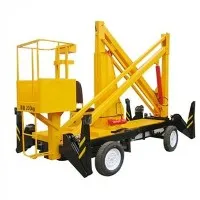
Introduction to common terms used in pallet stackers:
1. Rated lifting capacity of stacker: The rated lifting capacity of forklift refers to the maximum weight of the cargo that is allowed to be lifted when the distance between the center of gravity of the cargo and the front wall of the fork is not greater than the distance between the center of the load. When the center of gravity of the cargo on the fork exceeds the specified load center distance, due to the limitation of the longitudinal stability of the forklift, the lifting weight should be reduced accordingly.
2. Load center distance of stacker truck: Load center distance refers to the horizontal distance T from the center of gravity to the front wall of the vertical section of the fork when standard cargo is placed on the fork. For the 1T stacker truck, the specified load center distance is 500mm.
3. The maximum lifting height of the stacker truck: the maximum lifting height refers to the vertical position of the upper surface of the horizontal section of the forklift from the horizontal ground where the forklift is located when the stacker is fully loaded and the goods are lifted to the highest position on a flat and solid ground distance.
4. The inclination angle of the mast of the stacker: the inclination angle of the mast refers to the maximum inclination of the mast of the unloaded stacker on a flat and solid ground relative to its vertical position. The forward inclination angle is to facilitate fork picking and unloading of the goods; the backward inclination angle is to prevent the goods from slipping off the forks when the forklift is running with the goods. Generally, the forward inclination angle of the stacker forklift is 3°~6°, and the backward inclination angle is 10°~12°.
5. The maximum lifting speed of the stacker: the maximum lifting speed of the forklift usually refers to the maximum lifting speed of the goods when the forklift is fully loaded. Increasing the maximum lifting speed can improve operation efficiency, but if the lifting speed is too fast, cargo damage and machine damage accidents are prone to occur.
6. Stackers maximum travel speed: Increasing the travel speed has a great impact on improving the operating efficiency of the forklift. For forklifts with a lifting capacity of 1T, the minimum travel speed when fully loaded is not less than 17m/min.
7. Minimum turning radius: When the stacker is driving at a low speed without load and turning with a full steering wheel, the minimum distance from the outermost and innermost sides of the vehicle body to the turning center is called the minimum outside turning radius Rmin and the minimum inside turning radius rmin. . The smaller the minimum outside turning radius, the smaller the ground area required for the forklift to turn and the better the maneuverability.
8. Minimum ground clearance: The minimum ground clearance refers to the distance from the lowest point fixed on the vehicle body to the ground outside of the wheels. It indicates the ability of the forklift to cross the raised obstacles on the ground without collision. The greater the minimum ground clearance, the higher the passability of the forklift.
9. Wheelbase and wheelbase: Forklift wheelbase refers to the horizontal distance between the centerline of the front and rear axles of the forklift. Wheelbase refers to the distance between the center of the left and right wheels on the same axis. Increasing the wheelbase is conducive to the longitudinal stability of the forklift, but it increases the length of the vehicle body and the minimum turning radius; it is beneficial to the lateral stability of the forklift, but it will increase the overall width of the vehicle body and the minimum turning radius.
10. The minimum width of the right-angle channel: The minimum width of the right-angle channel refers to the minimum width of the channel that intersects at right angles for the forklift to travel back and forth. Generally, the smaller the minimum width of the right-angle channel, the better the performance.
11. The minimum width of the stacking channel: the minimum width of the stacking channel is the minimum width of the channel when the forklift is in normal operation.