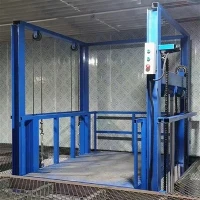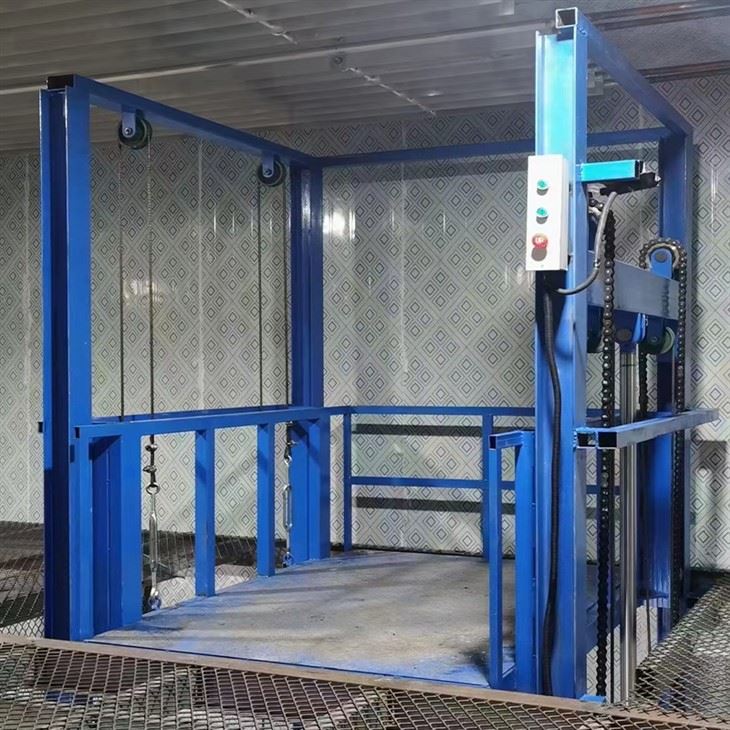


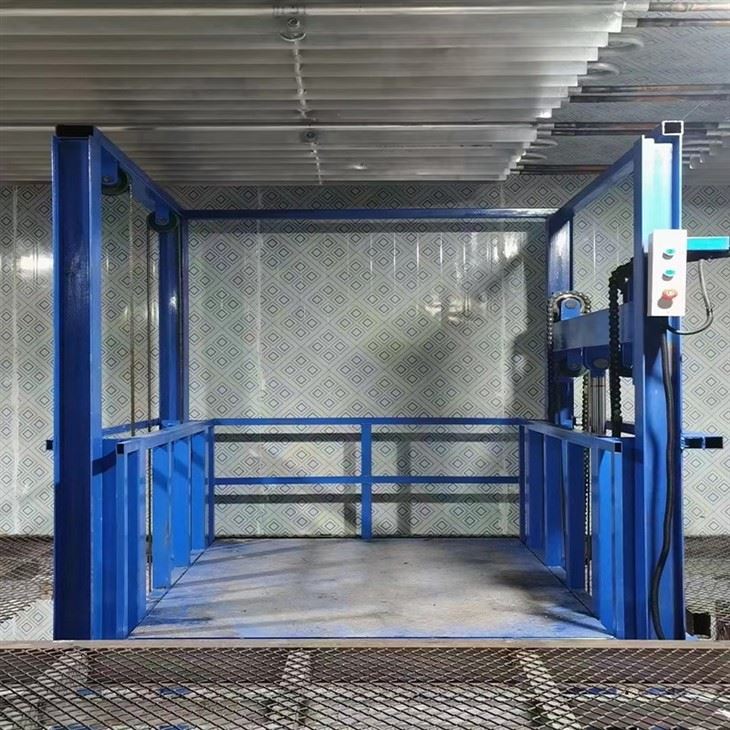
Qingdao Eterlift Machinery Co., Ltd. is one of the leading manufacturers and suppliers of 2 floor cargo lift in China, also supports customized service. As we have world-leading production equipment and strong manufacturing capabilities, we warmly welcome you to buy durable 2 floor cargo lift made in China here from our factory.

Easy to install:
The product arrives 80% pre-assembled. When you receive it, you just need to fix the guide rails to the wall and connect the AC power Add hydraulic oil as required. During use, the limit switches can be fine-tuned as needed.
Customized:
The load capacity, lifting height, and platform size of the cargo lift can be customized according to your requirements.
Durable:
The freight elevator use H-shape guide rails (Q355 steel), chrome-plated hydraulic cylinders, CE-certified electrical components, and highly wear-resistant seals; double 8-plate leaf chains and double 10 cm diameter safety cables.


Key Design Difficulties of Guide Rail Freight Elevators & Professional Solutions
Guide rail freight elevators are the core vertical transportation equipment for industrial factories, warehouses, logistics parks, and commercial buildings. Unlike passenger elevators, they prioritize heavy load capacity, continuous stable operation, and harsh environment adaptability. However, the non-standard customized structure, high load operation characteristics, and strict safety standards make the design and R&D of guide rail freight elevators far more technically challenging than ordinary lifting equipment.
Many elevator manufacturers and engineering teams often encounter problems such as platform jitter, rail wear, hydraulic system failure, and hidden safety hazards in actual projects. To help industry practitioners, purchasers, and technical engineers fully understand the core technical thresholds, this article systematically sorts out the key design difficulties of guide rail freight elevators and targeted optimization solutions based on national standards and actual engineering experience.
1. High-Precision Guide Rail System Design & Installation Calibration Difficulties
The guide rail is the "skeleton" of the guide rail freight elevator, which directly determines the operating stability, noise level, and service life of the equipment. It is the most fundamental and difficult link in the entire design process. According to the national standardGB/T7588.1-2020 Safety Code for Elevators, freight elevator carriages and counterweights must be guided by at least two rigid steel rails, with extremely strict requirements on material selection, structural design, and installation accuracy.
In terms of material design, it is difficult to balance rigidity, toughness, and wear resistance. Light-duty hollow rails are prone to bending and deformation under long-term heavy load, while ordinary solid square steel rails have excessive friction and fast wear. For heavy-duty freight elevators of 5-10 tons or even higher loads, designers must select high-quality Q235B or 45# cold-drawn steel rails, and optimize the rail cross-section structure to avoid local stress concentration.
In terms of installation and calibration accuracy, the error control threshold is extremely strict. Industry precision standards stipulate that the verticality deviation of the rail per 5 meters shall not exceed 2mm, the spacing deviation between the two rails shall be within ±2mm, and the step difference and gap at the rail joint shall not exceed 0.05mm and 0.5mm respectively. For high-rise freight elevators with a lifting height of more than 30 meters, minor rail installation errors will be amplified exponentially with the increase of height, resulting in platform jitter, roller friction, and even stuck operation in the later stage.
Core Optimization Solution: Adopt integral cold-drawn forming guide rails + full-section stress relief treatment; use laser calibration equipment for overall positioning during installation, and conduct secondary precision correction after rail welding and fixing to ensure parallelism and verticality meet standard requirements.
2. Heavy Load Structural Strength & Dynamic Balance Design Difficulties
Guide rail freight elevators mainly undertake heavy cargo transportation, with a load range covering 1-30 tons. Long-term full-load and overload intermittent operation puts forward ultra-high requirements for the structural strength and dynamic balance of the car frame, support beam, and connecting parts, which is another major design pain point.
First, static and dynamic load superposition stress problem. When the cargo is placed eccentrically (uneven loading) during actual use, the car frame will generate asymmetric torque. Ordinary uniform structural design is prone to local welding cracking, beam bending, and platform deformation after long-term operation. Especially for large-size car platforms, the deflection deformation under full load is difficult to control, which directly affects the fitting accuracy of the guide rail and roller.
Second, dynamic balance deviation in high-lift operation. With the increase of lifting height, the self-weight of the rail, chain, and hydraulic cylinder increases, and the unbalanced force of the equipment system changes dynamically. Traditional fixed counterweight design cannot adapt to the dynamic load change, resulting in unstable operation, increased power consumption, and accelerated wear of transmission parts.
Core Optimization Solution: Carry out finite element stress analysis on the whole machine before design, strengthen the welding structure of the stress concentration area of the car frame; adopt asymmetric reinforcement design for eccentric load scenarios; match graded counterweight system according to lifting height and load to realize dynamic balance adjustment of the whole machine.
3. Hydraulic Drive System Stability & Leakage Prevention Design Difficulties
Most guide rail freight elevators adopt hydraulic drive, which has the advantages of large load capacity and stable starting and stopping. However, the hydraulic system faces prominent design difficulties in constant pressure output, anti-leakage, and temperature resistance under long-term heavy load and frequent start-stop working conditions.
Long-term full-load operation will cause the hydraulic oil temperature to rise sharply. High temperature will reduce the viscosity of the hydraulic oil, lead to insufficient system pressure, slow lifting speed, and even platform slippage. In addition, the frequent impact of oil pressure during start-stop will cause fatigue wear of sealing parts. Ordinary sealing structures are prone to oil leakage after long-term use, which not only pollutes the factory environment but also causes potential safety hazards such as insufficient lifting power.
Moreover, the synchronous control of multi-cylinder hydraulic systems is difficult. Large-tonnage guide rail freight elevators need to be equipped with multiple hydraulic cylinders. Asynchronous oil supply and pressure difference of each cylinder will cause the platform to tilt and jitter, seriously affecting operation safety and cargo stability.
Core Optimization Solution: Equip with independent hydraulic cooling system to control the oil temperature within the safe range; adopt multi-layer composite high-temperature resistant sealing components and anti-fatigue pipeline layout; install hydraulic synchronous valve and pressure stabilizing device to realize real-time synchronous oil supply and constant pressure output of multi-cylinders.
4. Safety Protection System Matching & Fault Prevention Design Difficulties
Industrial freight elevators have high frequency of use and complex working conditions, and misoperation and equipment aging are inevitable. Therefore, the safety protection system needs to cover multiple risk points such as anti-falling, overload, over-height, and power failure, and the matching design of multiple safety devices is extremely difficult, which is also the key threshold to distinguish high-quality equipment from inferior products.
The first difficulty is anti-falling safety matching. The safety gear and speed limiter of the guide rail freight elevator need to be accurately matched with the rail specification and load weight. If the matching parameter is wrong, the safety gear cannot lock the rail in case of elevator stall and falling, or the locking force is too large to cause structural damage to the rail.
The second difficulty is intelligent fault early warning and protection. Traditional safety devices only realize passive protection after failure, lacking real-time monitoring of hidden dangers such as rail wear, hydraulic pressure abnormality, and structural loose connection. In addition, the emergency stop, power failure self-locking, and overload alarm systems need to be highly coupled with the control system, and program logic errors will lead to failure of safety functions.
Core Optimization Solution: Select safety gear and speed limiter matching the load and rail model in strict accordance with national standards; build a multi-dimensional safety protection system of "mechanical protection + electrical monitoring + intelligent early warning"; set independent emergency power supply and power failure self-locking device to ensure safe landing of the platform in case of sudden power failure.
5. On-Site Adaptability & Non-Standard Customization Design Difficulties
Different from standardized passenger elevators, guide rail freight elevators are mostly customized according to the on-site factory building conditions, and the complex on-site environment brings great challenges to structural design and layout optimization. The main difficulties are concentrated in space adaptation and building structure matching.
Many old factory buildings have limited space, no reserved machine room, and shallow or even no pit. The traditional guide rail elevator design requires a pit depth of 150-300mm and a fixed top floor height, which cannot adapt to the renovation needs of old factories. In addition, the wall bearing capacity of different factory buildings is different, and the rail support and fixing structure need to be designed in a targeted manner. Blind installation will cause unstable support and structural falling hazards.
At the same time, different industries have special working condition requirements: cold storage factories need low-temperature resistant design, dust workshops need fully enclosed dust-proof structure, and heavy logistics workshops need ultra-high frequency continuous operation design. These personalized requirements greatly increase the difficulty of non-standard design.
Core Optimization Solution: Adopt machine-room-less integrated design and zero-pit ramp auxiliary structure to adapt to old factory renovation; carry out on-site wall bearing test before design, and customize support and fixing scheme; realize modular personalized configuration for special working conditions such as low temperature, dust prevention, and high frequency operation.
6. Long-Term Wear Resistance & Aging Resistance Design Difficulties
Guide rail freight elevators are usually operated 8-16 hours a day in industrial scenarios, with harsh environments such as dust, humidity, and chemical corrosion. Long-term continuous operation leads to easy wear of guide rails, rollers, transmission chains and other moving parts, and aging of electrical components, which is a difficult problem that needs to be solved in the initial design stage.
If the wear resistance of the guide rail friction surface is not designed in place, long-term high-frequency friction will cause rail surface scratches and roller wear, resulting in increased operating noise and jitter. Humid and corrosive environments will cause rail rust and structural welding corrosion, reducing the overall structural strength and service life of the equipment. In addition, long-term load vibration will cause loose electrical wiring and aging of control components, leading to frequent equipment failures.
Core Optimization Solution: Conduct surface quenching and anti-corrosion coating treatment on the guide rail friction surface; adopt wear-resistant alloy rollers and anti-rust chains; carry out dust-proof, moisture-proof and anti-vibration optimization design for electrical control components, and reserve regular maintenance and wear replacement structure in the design stage.
Conclusion
The design of guide rail freight elevators is a systematic engineering integrating structural mechanics, hydraulic transmission, electrical control, and safety protection. Its core difficulties lie in the precise balance between high load stability, high-precision installation, complex working condition adaptation, and long-term operational reliability.
Excellent guide rail freight elevator design not only needs to strictly comply with GB/T7588.1-2020 and other industry standards, but also needs to carry out targeted optimization according to actual load, lifting height, on-site space and working environment. Only by solving the six core difficulties of guide rail precision design, heavy load structure balance, hydraulic stability, safety matching, on-site customization, and wear resistance and aging resistance can we manufacture industrial freight elevators with stable operation, long service life and high safety factor.
FAQs About Guide Rail Freight Elevator Design
Q1: What is the most critical factor affecting the stability of guide rail freight elevators?
The guide rail installation precision and structural rigidity are the core factors. Ultra-high precision rail calibration and high-strength anti-deformation structure can effectively avoid platform jitter and stuck operation.
Q2: How to solve the oil leakage and slippage problems of hydraulic freight elevators?
Optimize the hydraulic sealing structure, equip with a constant temperature cooling system, and match a pressure stabilizing and locking valve to ensure stable hydraulic pressure and no leakage under long-term load.
Q3: Can guide rail freight elevators be customized for old factory buildings with no pit?
Yes. The zero-pit design with an auxiliary ramp can completely adapt to the renovation of old factories without destroying the ground structure, meeting the installation requirements of limited space scenarios.
Hot Tags: 2 floor cargo lift, China, manufacturers, suppliers, factory, customized, buy, cheap, for sale, made in China, Double Rail Guide Freight Elevator, Freight Elevator For Workshop, Guide Rail Type Lifting Freight Elevator, Hydraulic Freight Elevator, Hydraulic Lift Freight Elevator, Small Freight Elevator 3 Meter