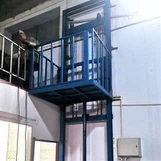
Qingdao Eterlift Machinery Co., Ltd. is one of the leading manufacturers and suppliers of hydraulic elevator wheelchair lift in China, also supports customized service. As we have world-leading production equipment and strong manufacturing capabilities, we warmly welcome you to buy durable hydraulic elevator wheelchair lift made in China here from our factory.
Elevators are essential vertical transportation equipment in modern buildings, widely used in residential buildings, commercial buildings, industrial factories, and other scenarios. When choosing an elevator for a building, many people are confused about hydraulic elevator and traction elevator-the two most mainstream elevator types. This article will comprehensively introduce the differences between hydraulic elevators and traction elevators, including their core structures, working principles, advantages, disadvantages, and applicable scenarios, helping you make an informed choice.
1. Hydraulic Elevator: Definition, Structure & Working Principle
1.1 Definition & Core Structure
A hydraulic elevator is a type of elevator that uses hydraulic power as the core driving source to push the car up and down through the pressure transmission of hydraulic oil. It is widely used in low-rise buildings and heavy-load scenarios, and its core structure is composed of four main parts that work together to ensure stable operation:
Hydraulic System: Including hydraulic pump, hydraulic cylinder, hydraulic valve, oil tank, and oil pipeline, it is the power core of the hydraulic elevator. The hydraulic pump converts mechanical energy into hydraulic energy, and the hydraulic valve controls the flow direction and pressure of hydraulic oil to push the piston of the hydraulic cylinder to move. This is the key component that distinguishes hydraulic elevators from traction elevators.
Car System: Composed of a car body and a car frame, it is used to carry people or goods. The bottom of the car is usually connected to the piston rod of the hydraulic cylinder and is directly driven up and down by the piston rod. It is simple in structure and suitable for heavy-load transportation.
Guidance System: Including guide rails and guide shoes, it limits the movement track of the car, ensures that the car rises and falls stably along the vertical direction, and avoids shaking or deviation. It is an important part to ensure the safety and comfort of hydraulic elevators.
Control System: Composed of a control cabinet, operation panel, sensors, etc., it is responsible for receiving instructions (such as floor selection, door opening and closing), controlling the start and stop of the hydraulic system, pressure adjustment, and realizing the automatic operation of the hydraulic elevator.
1.2 Working Principle
The working principle of the hydraulic elevator is based on Pascal's law, which states that when pressure is transmitted in a closed container, the pressure at each point is equal. The specific operation process is as follows, which is one of the key points for users to understand hydraulic elevators:
Ascent Process: After receiving the ascent instruction, the control cabinet starts the hydraulic pump. The hydraulic pump pressurizes the hydraulic oil in the oil tank and delivers it to the hydraulic cylinder through the hydraulic valve. The high-pressure hydraulic oil pushes the piston upward, and the piston drives the car frame and the car to rise synchronously. When it reaches the designated floor, the hydraulic pump stops working, the hydraulic valve locks, and the car remains stationary.
Descent Process: After receiving the descent instruction, the hydraulic valve opens. Under the action of the car's own weight and load, the hydraulic oil in the hydraulic cylinder slowly flows back to the oil tank. The piston moves downward with the backflow of hydraulic oil, driving the car to descend stably. When it reaches the target floor, the hydraulic valve closes to complete the descent action.
1.3 Pros & Cons of Hydraulic Elevators
1.3.1 Advantages
Strong Load-Bearing Capacity: The pressure transmission characteristics of the hydraulic system make it suitable for heavy-load scenarios. The common load range is 1000kg-10000kg, which is widely used in industrial freight elevators, warehouse elevators, and other heavy-load elevator applications. This is one of the biggest advantages of hydraulic elevators compared to traction elevators.
Smooth and Quiet Operation: The buffering effect of hydraulic oil can effectively reduce vibration and noise during the elevator's lifting process, providing a more comfortable riding experience. It is especially suitable for scenarios sensitive to noise, such as residential buildings and small office buildings.
Simple Structure & Easy Maintenance: Compared with traction elevators, hydraulic elevators have a simpler mechanical structure. The core components (hydraulic pump, hydraulic cylinder) have a low failure rate. Daily maintenance mainly focuses on the replacement of hydraulic oil and the inspection of seals, with low maintenance costs. This is a key advantage for users who pursue cost-effectiveness.
No Machine Room Required: Most hydraulic elevators can adopt a machine-room-less design, only needing a small hydraulic station on one side of the hoistway, saving building space. It is suitable for low-rise buildings (≤6 floors) or scenarios with limited machine room space, such as villas and small factories.
1.3.2 Disadvantages
Slow Lifting Speed: Limited by the flow rate of hydraulic oil, the speed of hydraulic elevators is usually 0.1m/s-0.5m/s, which is much lower than that of traction elevators. It is not suitable for high-rise buildings that require fast vertical transportation.
High Energy Consumption: The hydraulic pump needs to continuously consume electrical energy during operation, and there is energy loss in the transmission process of hydraulic oil. The long-term energy consumption is higher than that of traction elevators, which is not conducive to energy conservation and environmental protection.
Risk of Leakage: If the seals of the hydraulic system age or are damaged, hydraulic oil leakage may occur, which not only affects the operation of the elevator but also may pollute the environment. Regular inspection of the sealing performance is required, which increases the daily inspection cost.
Height Limitation: Due to the limited length of the hydraulic cylinder, the maximum lifting height of hydraulic elevators is usually no more than 20 meters, which is only suitable for low-rise buildings. It cannot meet the needs of high-rise building vertical transportation.
1.4 Applicable Scenarios of Hydraulic Elevators
Hydraulic elevators are mainly suitable for low-rise buildings (1-6 floors) and heavy-load scenarios. Common applications include: industrial factory freight elevators, warehouse goods transportation elevators, small office building elevators, villa elevators (home elevators), hospital sundry elevators, etc. It is the first choice for low-rise heavy-load elevator needs, which is a key point for users searching for "low-rise elevator options".

|
Size |
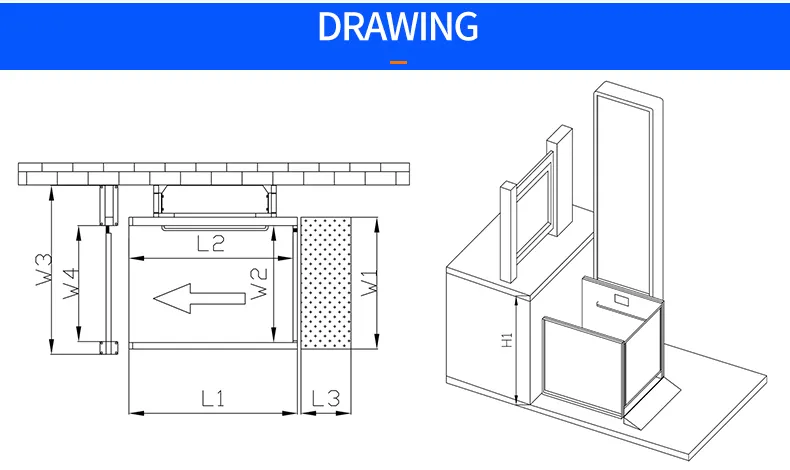
L1(cm) | 70-140 |
| L2(cm) | 60-130 | |
| L3(cm) | 50 | |
| W1(cm) | 50-100 | |
| W2(cm) | 40-90 | |
| W3(cm) | 80-1400 | |
| W4(cm) | 80 | |
| H1(cm) | 30cm to 1000cm(customized) | |
| voltage | 110V/220V/240V/380V/410V (50/60HZ) | |
| Motor | 1.5KW to 5KW | |
| Left door | YES/NO | |
| Right door | YES/NO | |
| Floor door | YES/NO | |
| Floor controller | YES/NO | |
| Automatic ramp | YES/NO | |
| Load capacity | 300KG | |
| Platform type | Pattern non-slip metal plate | |
| In and out direction | 90° Or 180°(customized) | |
| Working environment | Indoor and outdoor | |
| working temperature | -20°C - 60°C | |
| Installation mode | No foundation pit installation (fixed directly to concrete ground) | |
| Emergency stop button | Press the emergency button switch to control the machine to run, rise or fall | |
| Aluminum alloy bar |
When the platform is lowered will stop running immediately when it encounters an obstacle. |
|
Hot Tags: hydraulic elevator wheelchair lift, China, manufacturers, suppliers, factory, customized, buy, cheap, for sale, made in China, Electric Disabled Wheelchair Platform Lift Home Lift, Free Move Wheelchair Lift Elevator, Residential Vertical Platform Lifts, Wheelchair Lift Elevator For Disabled, Wheelchair Lift Elevator For Elderly, Wheelchair Lift Elevator For House