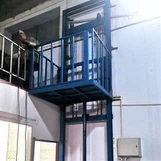
Qingdao Eterlift Machinery Co., Ltd. is one of the leading manufacturers and suppliers of aerial work lift table in China, also supports customized service. As we have world-leading production equipment and strong manufacturing capabilities, we warmly welcome you to buy durable aerial work lift table made in China here from our factory.


The development process of self-propelled scissor lifts involves several key stages, spanning from conceptual design to production and maintenance planning. Below is a breakdown of the development process, including both engineering and manufacturing aspects:
1. Market Research and Requirements Analysis
User Needs Assessment:Identify industries (construction, warehousing, maintenance) that require vertical lifting equipment.
Competitor Benchmarking:Analyze existing models in terms of height, weight capacity, power sources, maneuverability, safety, and cost.
Regulatory Compliance:Research relevant standards (e.g., ANSI A92, CE regulations, OSHA requirements).
2. Conceptual Design
Design Objectives:Determine lift height, load capacity, platform size, and intended usage environment (indoor/outdoor).
Basic Layout:Develop initial sketches or CAD concepts showing the scissor mechanism, platform, base, and drive system.
Technology Selection:Decide on hydraulic vs. electric actuators, power source (battery, diesel, hybrid), and control systems (joystick, remote).
3. Engineering Design
Mechanical Design:
Scissor Mechanism:Size and material of arms, pivot joints, and linkages.
Chassis and Platform:Structural strength, material selection (typically high-strength steel or aluminum).
Drive System:Electric motors and wheels for self-propulsion, differential steering.
Hydraulic/Electric Lifting System:
Hydraulic cylinders or electric linear actuators to raise/lower the platform.
Powertrain:
Electric battery packs (lithium-ion or lead-acid) for indoor lifts.
Diesel or dual fuel for outdoor applications.
Control Systems:
Embedded systems or programmable logic controllers (PLCs) for lift and drive control.
Safety features (emergency stop, tilt sensors, overload sensors).
4. Simulation and Prototyping
3D CAD Models and FEA (Finite Element Analysis):
Analyze stress, deformation, and stability under load.
Kinematic Simulations:
Validate movement of scissor arms and drive wheels.
Prototype Manufacturing:
Build a full-scale working model for testing and validation.
5. Testing and Validation
Functional Testing:
Load lifting and stability.
Drive system responsiveness.
Safety Testing:
Emergency descent.
Guardrails, platform locks, brakes.
Environmental Testing:
Performance under varying weather and surface conditions.
Compliance Testing:
Ensure design meets international and local safety and performance standards.
6. Production Planning
Manufacturing Process Design:
Fabrication (cutting, welding, machining).
Assembly lines for mechanical, electrical, and hydraulic systems.
Supplier Coordination:
Secure components like actuators, batteries, wheels, and control units.
Quality Assurance:
In-line inspection, final product testing, and certification.
7. Marketing and Launch
Sales Channels:Direct to construction firms, equipment rental companies, or distributors.
User Manuals and Training Materials:Safe operation, maintenance, and emergency procedures.


Hot Tags: aerial work lift table, China, manufacturers, suppliers, factory, customized, buy, cheap, for sale, made in China, Mobile Scissor Lift For House Repair, Mobile Scissor Lift Platform, Mobile Scissor Lift Tables, Mobile Scissor Lift Work Platform, Scissor Lifts, Self propelled Scissor Lift Platform For Rental