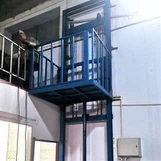
Qingdao Eterlift Machinery Co., Ltd. is one of the leading manufacturers and suppliers of compact mobile scissor lifts in China, also supports customized service. As we have world-leading production equipment and strong manufacturing capabilities, we warmly welcome you to buy durable compact mobile scissor lifts made in China here from our factory.


1. Start with the intended use and platform footprint
Decide whether loads will be uniformly distributed, concentrated (toolboxes, materials), or moving (people walking). Concentrated/dynamic loads reduce allowable capacity.
2.Check/establish manufacturer rating
If the lift is commercially supplied, use the manufacturer's rated capacity and placard. Never exceed it in use; standards require this. If you are designing or modifying, proceed to engineering checks.
3.Stability / tipping analysis (critical)
Determine the combined center-of-gravity (machine + load) envelope at maximum platform height and any platform extension. Compute whether the CG remains inside the stability polygon (wheelbase/support footprint).
Consider sideways overturn and longitudinal overturn under uneven loads and on allowable slope (many compact units are for indoor flat floors only). Standards require stability checks and often limit outdoor/windy use. Wind loading can reduce allowable personnel/load capacity for outdoor use.
4.Ground/bearing checks
Check wheel/footprint bearing pressure vs floor rating (grating, mezzanine). Concentrated loads can damage flooring or cause instability.
5.Fatigue and dynamic loading
If the load will be repeated frequently, check fatigue life for welded joints and pins. Allow a dynamic/impact factor where loads are moved or set down abruptly.


Hot Tags: compact mobile scissor lifts, China, manufacturers, suppliers, factory, customized, buy, cheap, for sale, made in China, Battery Powered Mobile Scissor Lift, Mobile Scissor Lift For House Repair, Mobile Scissor Lift Platform, Scissor Lifts, Self propelled Mobile Scissor Lift, Self Propelled Scissor Lift Platform