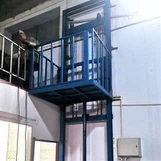
Fixed Scissor Lift Relay Explosion-Proof Rating: Selection Standards & Application Guidelines
Fixed scissor lifts are essential equipment in industries like chemical, petroleum, and warehousing, where flammable and explosive hazards are common. As the core component of the electrical control system, the explosion-proof rating of relays directly impacts the safe operation of fixed scissor lifts. This guide covers everything you need to know about explosion-proof relay ratings for fixed scissor lifts, including classification, selection principles, and application precautions-helping businesses choose the right components and maintain operational safety.
1. Core Role of Explosion-Proof Relays for Fixed Scissor Lifts
Relays serve as critical nodes in fixed scissor lifts, responsible for circuit switching, signal control, and overload protection. They connect the control unit to actuators such as hydraulic pump motors and lifting solenoid valves. In flammable and explosive environments, contact arcs and coil heating generated by relays during operation can easily ignite flammable media if the relay does not meet the required explosion-proof rating, leading to explosions or fires.
Explosion-proof relays isolate internal ignition sources from the external hazardous environment through special structural designs (e.g., flameproof enclosures, intrinsic safety). This ensures no safety risks under normal or fault conditions. All explosion-proof relays for fixed scissor lifts must comply with the national standard GB/T 3836.1-2021 and international explosion-proof standards.
2. Classification of Explosion-Proof Ratings for Fixed Scissor Lift Relays (Key Points)
An explosion-proof relay's rating consists of five parts: "Ex explosion-proof mark + explosion-proof type + equipment category + temperature class + protection level". Below is a breakdown tailored to fixed scissor lift applications, suitable for different industrial safety needs.
1.1 Common Explosion-Proof Types
Flameproof Type (Mark "d"): The most popular choice for fixed scissor lifts. A high-strength enclosure contains ignition sources, withstands internal explosion pressure, and prevents flame propagation. It is divided into db (for conventional explosion-proof scenarios) and dc grades. The enclosure is usually made of cast aluminum alloy or stainless steel, suitable for most chemical and petroleum applications.
Intrinsic Safety Type (Mark "i"): Limits circuit voltage and current to ensure energy is insufficient to ignite flammable media. Compact and lightweight, it is ideal for low-power scenarios such as control circuits and signal transmission. Divided into ib and ic grades, it is suitable for dusty or narrow installation locations.
1.2 Equipment Category & Gas Group
Relays for fixed scissor lifts belong to Class Ⅱ (for non-coal mine scenarios). They are divided into 3 groups based on the hazard level of flammable gases, with each group suitable for specific environments. Selection must strictly match the on-site flammable medium type.
Class ⅡA: Suitable for low-risk gases (e.g., propane), used in ordinary flammable and explosive warehousing and light chemical scenarios.
Class ⅡB: Suitable for medium-risk gases (e.g., ethylene), widely used in mainstream industries like petroleum and chemical-making it the industry's standard choice.
Class ⅡC: Suitable for high-risk gases (e.g., hydrogen, acetylene), used in high-risk chemical scenarios. It has higher explosion-proof requirements and a relatively higher manufacturing cost.
Note: Higher groups are downward compatible. Lower groups cannot be used in high-requirement scenarios to avoid safety hazards caused by insufficient explosion-proof performance.
1.3 Temperature Class (Common Specifications)
Class T4 (≤135℃): Suitable for normal temperature working conditions of most fixed scissor lifts. It is the most widely used and cost-effective option.
Class T5 (≤100℃) & Class T6 (≤85℃): Suitable for special scenarios such as low ignition point media and high temperatures, offering higher safety.
1.4 Equipment Protection Level (EPL)
The commonly used Gb level (high protection, suitable for Zone 1 and Zone 2 flammable gas environments) meets the conventional explosion-proof requirements of fixed scissor lifts. For high-risk scenarios, the Ga level (very high protection, suitable for Zone 0) is recommended to enhance safety.
3. Selection Principles for Explosion-Proof Relays of Fixed Scissor Lifts
Match On-Site Environment & Medium: Clarify the on-site hazardous area (e.g., Zone 1/Zone 2) and flammable gas group. Selection must be fully compatible with the environment. Refer to on-site safety evaluation reports to avoid selection errors.
Align with Functional Purpose: Control and intermediate relays can be either intrinsic safety or flameproof type. Overload protection relays are preferably flameproof with a temperature class of T4 or higher to ensure no safety hazards during overload heating.
Comply with Standards & Certifications: Choose products with national explosion-proof certification and explosion-proof certificates. Ensure compliance with GB/T 3836 series, GB19854-2018, and international standards (e.g., ATEX, IECEx). The relay's explosion-proof rating must match that of the entire fixed scissor lift.
Adapt to Working Conditions: Prioritize relays with a protection level of IP65 or higher to suit high-humidity and dusty environments. Ensure they meet the requirements of equipment start-stop frequency and load fluctuations for long-term stable operation.
4. Application Precautions
Strictly prohibit use beyond the rated grade. Relays with low gas groups or temperature classes cannot be used in high-requirement scenarios, as this may cause safety accidents.
Standardize installation and maintenance. Ensure the flameproof enclosure is intact and well-sealed, and cable laying meets explosion-proof requirements. Do not disassemble the relay without authorization. Replace damaged relays with products of the same model and grade.
Conduct regular verification quarterly. Check contact condition, coil temperature, and explosion-proof sealing performance. Confirm the validity of the explosion-proof certificate to ensure normal equipment operation.
Do not modify the relay structure or replace explosion-proof relays with ordinary ones. Even for temporary emergencies, use explosion-proof products of the same grade and model.
5. Conclusion
The explosion-proof rating of relays is critical for the safe operation of fixed scissor lifts. The mainstream choice is the Ex d ⅡB T4 Gb flameproof type, which meets the needs of most chemical, petroleum, and warehousing scenarios. For high-risk environments, select Class ⅡC or Ga grade products. By strictly following selection principles and standardizing installation and maintenance, enterprises can effectively prevent safety accidents, ensure production safety, and reduce operational risks.


Hot Tags: hydraulic lifting table, China, manufacturers, suppliers, factory, customized, buy, cheap, for sale, made in China