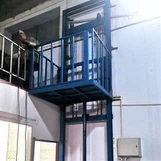
Matching the load capacity and motor power of a scissor lift platform is essential to ensure safe, efficient, and reliable operation. Here's how you can approach it, step by step:
🔧 1. Understand Key Parameters
| Parameter | Description |
|---|---|
| Load capacity (Q) | Maximum weight the lift must raise (kg or lbs) |
| Lifting height (H) | Maximum vertical height the lift must reach (m or ft) |
| Lifting time (t) | Desired time to reach full height (s) |
| Motor efficiency (η) | Typically between 0.7 and 0.9 |
| Screw/hydraulic efficiency (if applicable) | Typically 0.6–0.8 for hydraulic systems |
⚙️ 2. Calculate Work Done
Work (energy) needed to lift the load is:

Where:
Q = load in kg
g = acceleration due to gravity (9.81 m/s²)
H = lifting height in meters
⚡ 3. Calculate Required Power

Convert this to kilowatts (kW):

Then account for system efficiency:

Where ηtotal\eta_{\text{total}} is the product of motor efficiency and mechanical/hydraulic efficiency.
🔍 4. Example Calculation
Given:
Load capacity: 1000 kg
Lifting height: 5 m
Lifting time: 20 seconds
Total efficiency: 0.75

So, you'd select a motor rated at at least 3.5 kW, or round up to a 4 kW motor for safety.
✅ Design Tips
Add safety margin: Always choose a motor slightly above calculated value.
Duty cycle: Consider how often the lift operates (continuous vs intermittent).
Speed control: Use a VFD (Variable Frequency Drive) for smoother control.
Brake system: Ensure the motor includes or is coupled with a brake if needed.


Hot Tags: scissor dock lift, China, manufacturers, suppliers, factory, customized, buy, cheap, for sale, made in China